15 Best Cars from Car Companies That No Longer Exist
Discover 15 legendary cars from discontinued automobile brands, including DeLorean, Pontiac, Plymouth, Saab, Studebaker, and more.
In this article
- 15 Best Cars from Car Companies That No Longer Exist
- 1. DeLorean DMC-12 – DeLorean Motor Company
- 2. Pontiac GTO – Pontiac
- 3. Saab 900 Turbo – Saab Automobile
- 4. Plymouth Hemi Cuda – Plymouth
- 5. Oldsmobile 442 – Oldsmobile
- 6. Tucker 48 – Tucker Corporation
- 7. Studebaker Avanti – Studebaker
- 8. AMC AMX – American Motors Corporation
- 9. Mercury Cougar – Mercury
- 10. Packard Caribbean – Packard
- 11. Jensen Interceptor – Jensen Motors
- 12. Triumph TR6 – Triumph Motor Company
- 13. Lancia Stratos – Lancia
- 14. Eagle Speedster – Eagle
- 15. Vector W8 – Vector Aeromotive
- Why Did These Car Companies Disappear?
- Are These Classic Cars Still Valuable Today?
- Final Thoughts
15 Best Cars from Car Companies That No Longer Exist
Introduction
The automotive industry has witnessed the rise and fall of many legendary car manufacturers. Some companies disappeared because of financial difficulties, changing market conditions, poor management, or intense competition. Others were absorbed by larger automotive groups, leaving behind brands that are now part of automotive history.
However, the disappearance of these manufacturers did not mean the end of their legacy. Many produced extraordinary vehicles that remain highly desirable among collectors, enthusiasts, and classic car lovers.
From powerful American muscle cars to futuristic sports cars and luxurious European classics, here are 15 of the best cars from automobile companies that no longer exist.
1. DeLorean DMC-12 – DeLorean Motor Company
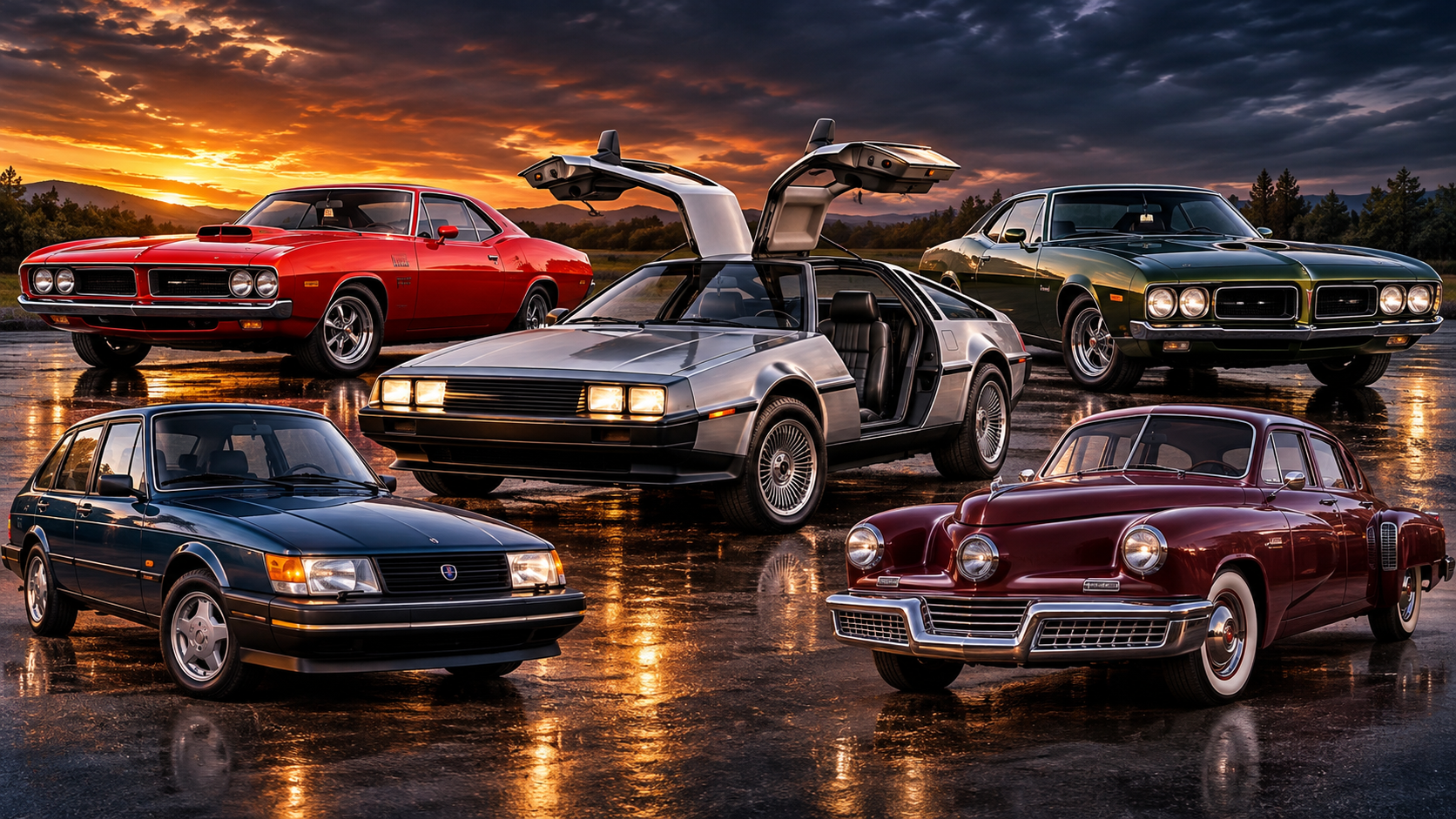
The DeLorean DMC-12 is arguably one of the most recognizable sports cars ever produced. Manufactured by the original DeLorean Motor Company, the vehicle became famous for its distinctive stainless-steel body, gull-wing doors, and futuristic appearance.
Although its performance was not particularly impressive compared with other sports cars of its era, the DMC-12 achieved worldwide recognition after appearing in the Back to the Future movie franchise.
The original DeLorean Motor Company collapsed in 1982, but its iconic vehicle remains a symbol of automotive creativity and ambition.
Why it remains iconic: Its unforgettable design and legendary movie appearances.
2. Pontiac GTO – Pontiac
Often considered one of the cars that helped launch the American muscle car era, the Pontiac GTO is a true automotive legend.
Introduced in 1964, the GTO combined a relatively affordable midsize body with a powerful V8 engine. It quickly became popular among drivers who wanted serious performance without spending money on an expensive sports car.
The first-generation GTO models remain particularly desirable among classic car collectors.
Pontiac was discontinued by General Motors in 2010, bringing an end to one of America's most recognizable automotive brands.
Why it remains iconic: Its contribution to the golden age of American muscle cars.
3. Saab 900 Turbo – Saab Automobile
Saab developed a reputation for producing vehicles with distinctive Scandinavian styling, innovative engineering, and impressive turbocharged performance.
The Saab 900 Turbo became one of the manufacturer's most celebrated models. It offered a unique combination of comfort, practicality, safety-focused engineering, and exciting performance.
Its unusual dashboard layout, recognizable design, and turbocharged engine helped distinguish it from mainstream European competitors.
Saab Automobile eventually entered bankruptcy in 2011.
Why it remains iconic: Its distinctive engineering and character make it a favorite among enthusiasts.
4. Plymouth Hemi Cuda – Plymouth
The Plymouth Hemi Cuda is one of the most desirable American muscle cars ever built.
Produced during the golden age of American performance vehicles, the Hemi Cuda featured an aggressive design and an available 426 Hemi V8 engine.
Its combination of power, rarity, and distinctive styling has made it extremely valuable in the classic car market.
Plymouth was discontinued in 2001, but the Hemi Cuda remains one of the brand's greatest achievements.
Why it remains iconic: Exceptional performance, rarity, and legendary muscle car styling.
5. Oldsmobile 442 – Oldsmobile
Oldsmobile was once one of America's most respected automotive manufacturers, producing everything from luxury vehicles to high-performance machines.
The Oldsmobile 442 became particularly famous for its powerful engines and aggressive styling.
Its name originally represented a four-barrel carburetor, four-speed manual transmission, and dual exhaust system, although the specifications evolved throughout its production history.
Oldsmobile was discontinued in 2004 after more than a century of automotive history.
Why it remains iconic: Its combination of American muscle, performance, and classic styling.
6. Tucker 48 – Tucker Corporation
The Tucker 48 is one of the most fascinating automobiles in automotive history.
Developed by Preston Tucker, the vehicle introduced several unusual design ideas, including a central third headlight that turned with the steering system.
It also featured advanced safety concepts for its time, including a padded dashboard and a reinforced passenger compartment.
Unfortunately, financial and legal difficulties prevented the Tucker Corporation from becoming a successful mass-production manufacturer. Only 51 cars were completed, including the prototype.
Today, the Tucker 48 is among the most historically significant American automobiles ever produced.
Why it remains iconic: Its innovative engineering, rarity, and remarkable history.
7. Studebaker Avanti – Studebaker
The Studebaker Avanti was a bold attempt to create a futuristic American sports coupe.
Designed by industrial designer Raymond Loewy and his team, the Avanti featured a distinctive aerodynamic body without a conventional front grille.
Its styling was dramatically different from many American cars of the 1960s.
Although Studebaker ended its American automobile production in 1966, the Avanti continued to influence automotive enthusiasts and later specialist manufacturers.
Why it remains iconic: Its futuristic design and unusual styling.
8. AMC AMX – American Motors Corporation
American Motors Corporation, commonly known as AMC, produced several interesting vehicles during its existence.
Among its most memorable creations was the AMC AMX, a two-seat performance car introduced in 1968.
It offered powerful V8 engine options and distinctive American styling, making it a serious competitor in the muscle car market.
AMC was acquired by Chrysler in 1987, but the AMX remains one of the company's most celebrated performance vehicles.
Why it remains iconic: Its combination of compact dimensions and powerful V8 performance.
9. Mercury Cougar – Mercury
Mercury was an American automotive brand positioned between Ford's mainstream vehicles and Lincoln's luxury offerings.
The first-generation Mercury Cougar, introduced in 1967, became particularly popular for its elegant styling and performance-oriented character.
It offered a more refined alternative to traditional muscle cars while maintaining impressive V8 performance.
Ford discontinued the Mercury brand in 2010.
Why it remains iconic: Its elegant styling and successful combination of luxury and performance.
10. Packard Caribbean – Packard
Packard was once regarded as one of America's premier luxury automobile manufacturers.
The Packard Caribbean represented the company's commitment to sophisticated design, powerful engines, and premium craftsmanship.
Available as a convertible and later a hardtop, the Caribbean featured distinctive styling and luxurious interior appointments.
Packard's independent automobile production ended in 1958 following its merger with Studebaker.
Why it remains iconic: Its luxurious craftsmanship and classic American elegance.
11. Jensen Interceptor – Jensen Motors
British manufacturer Jensen Motors created several interesting performance and luxury vehicles, but the Interceptor remains its most famous model.
Introduced in the 1960s, the Jensen Interceptor combined British craftsmanship with powerful American V8 engines.
Its distinctive rear glass design and luxurious interior made it stand out among European grand touring cars.
The original Jensen Motors ceased operations in 1976, although the Interceptor name has continued to attract automotive enthusiasts.
Why it remains iconic: Its combination of British luxury and American muscle.
12. Triumph TR6 – Triumph Motor Company
Triumph was an important British automotive manufacturer known for producing stylish sports cars.
The Triumph TR6 became one of its most successful and recognizable models.
With its classic roadster proportions, six-cylinder engine, and engaging driving experience, the TR6 captured the spirit of traditional British sports car manufacturing.
Triumph's car production eventually ended in 1984.
Why it remains iconic: Its timeless roadster styling and enjoyable driving experience.
13. Lancia Stratos – Lancia
Lancia is a historic Italian automotive marque that is no longer an independent manufacturer, although the brand itself survives.
The Lancia Stratos deserves recognition because of its extraordinary contribution to rally racing.
Designed with a dramatic wedge-shaped body and powered by a Ferrari-derived V6 engine, the Stratos became a dominant force in international rally competition.
It won three consecutive World Rally Championship manufacturers' titles between 1974 and 1976.
Why it remains iconic: Its extraordinary rally achievements and unmistakable Italian design.
14. Eagle Speedster – Eagle
Eagle is a specialist British automotive manufacturer rather than a conventional mass-market car company. Its Speedster is included as an example of how small automotive businesses can create extraordinary vehicles.
Inspired by the legendary Jaguar E-Type, the Eagle Speedster combines classic British sports car design with modern engineering and craftsmanship.
Although Eagle itself is not a defunct manufacturer, the car celebrates the legacy of an automotive era that has largely disappeared.
Why it remains iconic: Its beautiful interpretation of classic British sports car design.
15. Vector W8 – Vector Aeromotive
The Vector W8 was an ambitious American supercar developed by Vector Aeromotive.
With its angular bodywork, futuristic cockpit, and twin-turbocharged V8 engine, the W8 looked more like a concept car than a conventional production vehicle.
It represented an attempt to challenge established European supercar manufacturers.
Production was extremely limited, and Vector Aeromotive struggled to establish itself as a major manufacturer.
Why it remains iconic: Its futuristic appearance and ambitious American supercar engineering.
Why Did These Car Companies Disappear?
The disappearance of historic automobile manufacturers happened for different reasons.
Some struggled financially because they could not compete with larger manufacturers. Others experienced declining sales, expensive production costs, management problems, or changes in consumer preferences.
The automotive industry also became increasingly competitive as manufacturers invested heavily in technology, safety, manufacturing capacity, and global distribution.
Companies that could not adapt often disappeared, merged with larger businesses, or discontinued their automotive brands.
Are These Classic Cars Still Valuable Today?
Many vehicles produced by discontinued manufacturers have become highly desirable collector cars.
Their value often depends on several factors:
- Rarity: Limited-production vehicles can attract significant interest from collectors.
- Historical importance: Cars that introduced innovative technology or influenced automotive design can become highly collectible.
- Condition: Original, well-maintained examples generally attract greater interest.
- Performance: Legendary engines and motorsport achievements can increase a vehicle's appeal.
- Cultural significance: Cars featured in movies or associated with important historical moments often develop a dedicated following.
Some examples, particularly rare Tucker 48 and Plymouth Hemi Cuda models, have achieved extraordinary prices at classic car auctions.
Final Thoughts
The automotive industry is filled with stories of companies that created extraordinary vehicles but could not survive the changing business environment.
From the futuristic DeLorean DMC-12 to the powerful Plymouth Hemi Cuda and innovative Tucker 48, these cars demonstrate that a manufacturer's disappearance does not necessarily mean its legacy will disappear.
Many of these vehicles remain admired decades after their manufacturers closed their doors. Their designs, engineering achievements, and historical importance continue to inspire new generations of car enthusiasts.
Which of these discontinued car manufacturers produced your favorite vehicle?
Written by mymuzplay
Articles, news and guides from mymuzplay.